Night Scuba Diving: My First Experience, Safety Tips and What You’ll See

Night scuba diving was something I was both excited and nervous about trying. I did my first night dive on Elba Island in Italy in 2019, and I still remember looking out at the dark water and wondering what it would be like once we descended!
Since then, I’ve also dived at night in Coron, Palawan, and Siquijor in the Philippines.
If you’re thinking about giving it a try, I’ll share what my first night dive was like, what gear to bring, how to stay safe and what you might see underwater. Let’s dive in!
What Is Night Scuba Diving Actually Like?
My first night dive was in September 2019, when I completed my SSI Night Diving and Limited Visibility Specialty with Sub Now Diving Center on Elba Island.
I dived with Antonio, the owner, boat captain and dive guide. His wife, Roberta, and their three children were also on board, and two of the kids, who were around 12 at the time, were diving with us. I remember thinking how brave they were while I was still feeling a little nervous myself!
I’d already dived with Antonio before, though, so I trusted him and felt comfortable with the crew. We had a good briefing, a comfortable boat and a relaxed atmosphere. That made my first experience much more enjoyable.
Once you’re underwater, you notice the difference immediately. You can’t look across the whole reef the way you normally would during the day. Instead, you’re seeing what’s inside the beam of your flashlight, and you have to pay more attention to where your buddy or guide is.
But that’s also the fun part. You slow down, look more closely and start noticing animals you might swim straight past during a daytime dive.
I actually have a video from that very first night dive in Elba! If you’re curious about what it’s really like to dive after dark, have a look below. You’ll get a better idea of what you can see underwater with just your flashlight.

Would I do my first night dive the same way again? Absolutely. I’d choose an experienced guide I trust, a manageable dive site and a crew that takes safety seriously.
For context, the U.S. Bureau of Reclamation Diving Manual describes specific illumination and surface-visibility requirements for its own operations.
These are not universal recreational equipment rules, but they illustrate why being able to see and be located both matter after dark.
How Night Scuba Diving Is Different From Diving During the Day
You still need the same basic scuba skills: good buoyancy, air management, awareness of your depth and communication with your buddy. The difference is that you have fewer visual references around you.
Here’s what changes:
| During a day dive | During a night dive |
|---|---|
| You can usually see more of the reef and its landmarks | Your flashlight illuminates a smaller area |
| Standard hand signals are easier to see | You may need to illuminate your hand or use agreed light signals |
| Navigating by visible reef features is often easier | You’ll rely more on a compass, your route and your guide |
| You see animals active during the day | Some nocturnal animals are more active, while other fish are resting |
| A flashlight is often optional | A primary and backup dive light are essential |
I find night diving more enjoyable when I take my time. There’s no need to rush around trying to cover as much reef as possible.
Also, don’t assume that a shallow night dive is automatically easy. Darkness, current, poor visibility or an unfamiliar site can make things more demanding. The dive still needs to match your certification, experience and comfort level.
If you’re curious about a very different kind of night dive, the Kona Snorkel Trips blackwater diving guide explains how offshore blackwater diving differs from exploring a reef.
One peer-reviewed study in the Journal of Travel Medicine examined 967 adult recreational-diver fatalities in the United States and Canada from 2004 through 2013.
Night diving appeared in 10% of harvester fatalities versus 3% of non-harvester fatalities, with an odds ratio of 4.0, a 95% confidence interval of 1.5-10.9 and a p-value of 0.007.
The groups differed in other ways, and this comparison of fatal incidents does not show that darkness caused the deaths or tell you the risk of any individual night dive.
For me, the practical lesson is to keep the dive simple and manage the extra workload.
Essential Night Diving Gear: What I Wouldn’t Dive Without
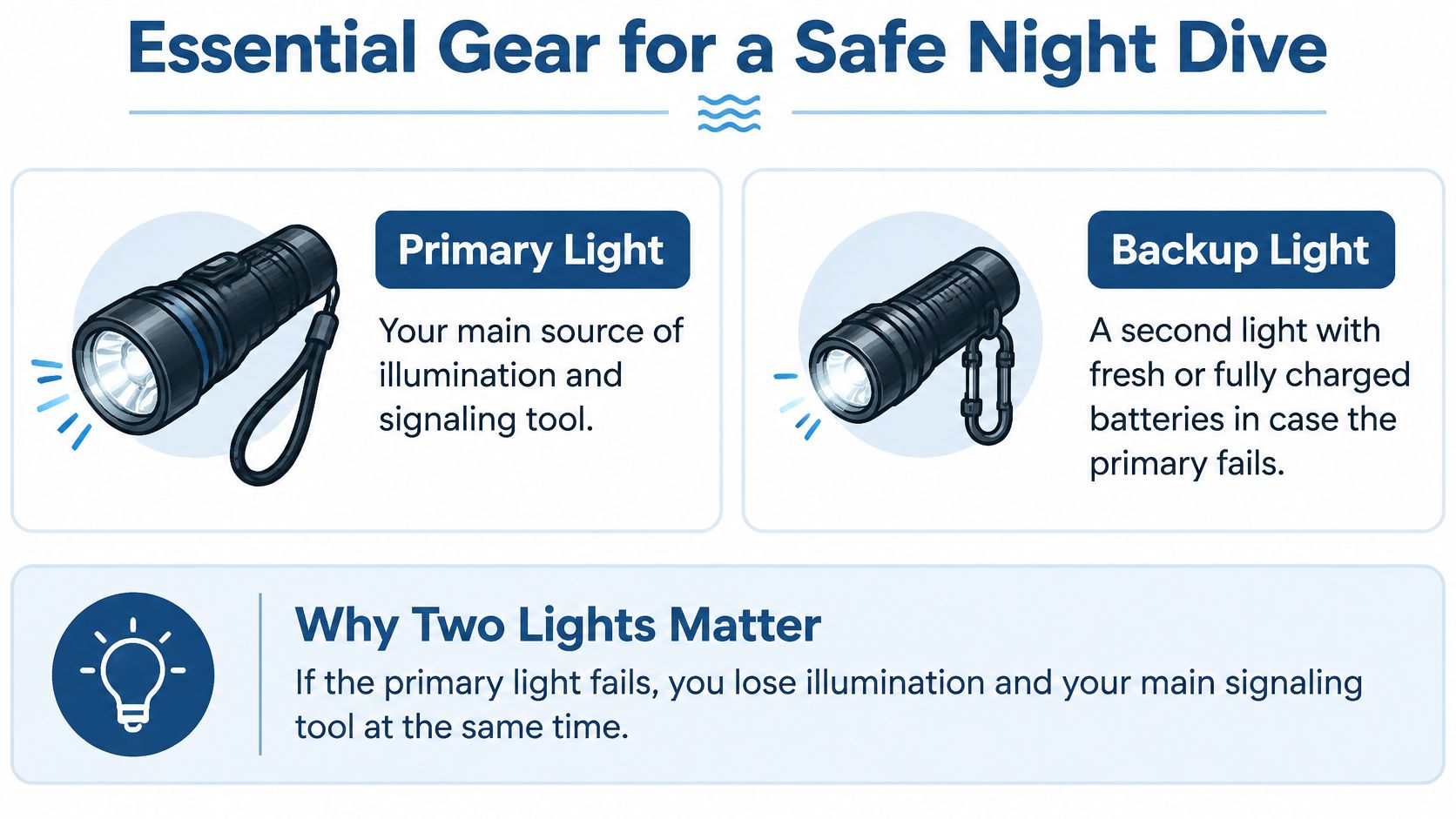
The first thing I’d pack? Two underwater flashlights. Not one, two!
If your main light fails, you need a working backup. It can be surprisingly dark underwater, and you don’t want to discover that your spare torch has a flat battery when you need it.
University of California, Santa Barbara night-diving guidance also recommends checking a primary and at least one backup light before entry, as well as planning visible markers for divers and the exit.
Before a night dive, these are the things I’d check:
Primary dive light: Make sure it’s suitable for diving, fully charged and easy to operate with wet hands or gloves.
Backup dive light: Carry an independent spare somewhere you can reach easily.
Dive computer and gauges: Check that you can read your depth, remaining gas and computer display in the dark.
Compass: Make sure you know how to use it, particularly if you’re diving without following a guide.
Buddy or tank marker light: Use one if it’s part of the operator’s night-diving setup, so your group can recognise each other.
Exit marker: Check how you’ll recognise the boat or shore exit and who is responsible for keeping its marker in place.
Exposure protection: Remember that you’ll be sitting on a boat or getting out of the water after sunset. Bring something warm and dry for afterwards.
You don’t need the most expensive flashlight in the dive shop. I’d rather have a reliable light with simple controls than one with lots of modes I can’t remember how to use underwater.
If you’re unsure about staying warm, my guide to what to wear under a wetsuit might help.
PRO TIP: Charge both your primary and backup lights the day before, then test them again during your pre-dive checks. Make sure you can reach your spare without having to dig around your BCD pockets.
Night Dive Signals and Staying Close to Your Buddy
If there’s one thing I’d emphasise, it’s this: don’t lose track of your buddy or dive guide.
I’m serious! It’s easy to get distracted when you spot something interesting, especially if you’re trying to take underwater photos. You look up after a few seconds, and suddenly you’re not quite sure where everyone went.
Before getting in, make sure you and your buddy understand the light signals you’re going to use. The Scuba Diving night-skills guide describes circular, side-to-side and vertical light movements.
Common signals include making a slow circle with your beam for “OK” and moving the beam side to side to get attention or indicate a problem. But don’t assume everyone uses exactly the same signals. Agree on them during the briefing.
If you need to make a normal hand signal, shine your light on your own hand so your buddy can see it. And please don’t point a powerful flashlight straight into someone’s eyes!
Your briefing should also cover the dive route, maximum depth, gas limits, entry and exit points, and what to do if you become separated.
What if you lose your buddy at night?
First, don’t swim off in a random direction looking for them. Stop, maintain your buoyancy and follow the lost-buddy procedure agreed before the dive.
That normally means a brief, controlled search followed by a safe ascent if you can’t re-establish contact, but the exact procedure should be agreed with your instructor or dive leader. Don’t make up a new plan underwater.
I also recommend leaving the camera behind for your first night dive if taking photos would distract you. There’ll be plenty of opportunities later, once you’re comfortable handling the light and keeping track of your group.
For a refresher on basic dive habits, have a look at my scuba diving principles.
PRO TIP: Before entering the water, ask your guide how close the group should stay and what their separation procedure is. Knowing the plan beforehand is far better than trying to work it out in the dark.
Is Night Scuba Diving Safe?
Night diving can be a safe and rewarding experience when the site, conditions, training and equipment are appropriate. But I wouldn’t treat it as just another day dive with a flashlight.
For your first night dive, I’d choose somewhere relatively sheltered with a straightforward route and easy entry and exit. Better still, dive a site you’ve already visited in daylight, if possible.
I would also avoid adding too many new things at once. Your first night dive isn’t the time to test unfamiliar rental equipment, practise advanced photography techniques or push your depth limits.
Before you dive, make sure:
The weather, current and visibility are suitable for the group.
Both your primary and backup lights work.
Your buddy checks and dive briefing are complete.
You understand the planned depth, gas limits and exit procedure.
You’re feeling comfortable and not being pressured to join.
If conditions change or you feel genuinely uncomfortable, it’s fine to call the dive off. You can always try again another time.
The Divers Alert Network guide to night diving is worth reading if you’d like more detailed safety advice. You can also read my article on whether scuba diving is dangerous for a broader look at managing risks underwater.
The Divers Alert Network guide to decompression sickness is a useful reminder that depth, time and ascent still matter: darkness doesn’t give you extra bottom time. Follow your computer and the ascent plan you agreed during the briefing.
What Marine Life Can You See During a Night Dive?
This is one of my favourite reasons to dive at night. You get to see how the reef changes after the sun goes down.
I’ve done night dives in Elba in Italy, Coron in Palawan and, most recently, Siquijor in the Philippines. The Siquijor dive was particularly memorable because I saw sponge crabs for the first time.
I spotted at least two of them crawling around the reef, each carrying a bright orange sponge on its back. They looked like little crabs wearing oversized hats! I couldn’t stop watching them.
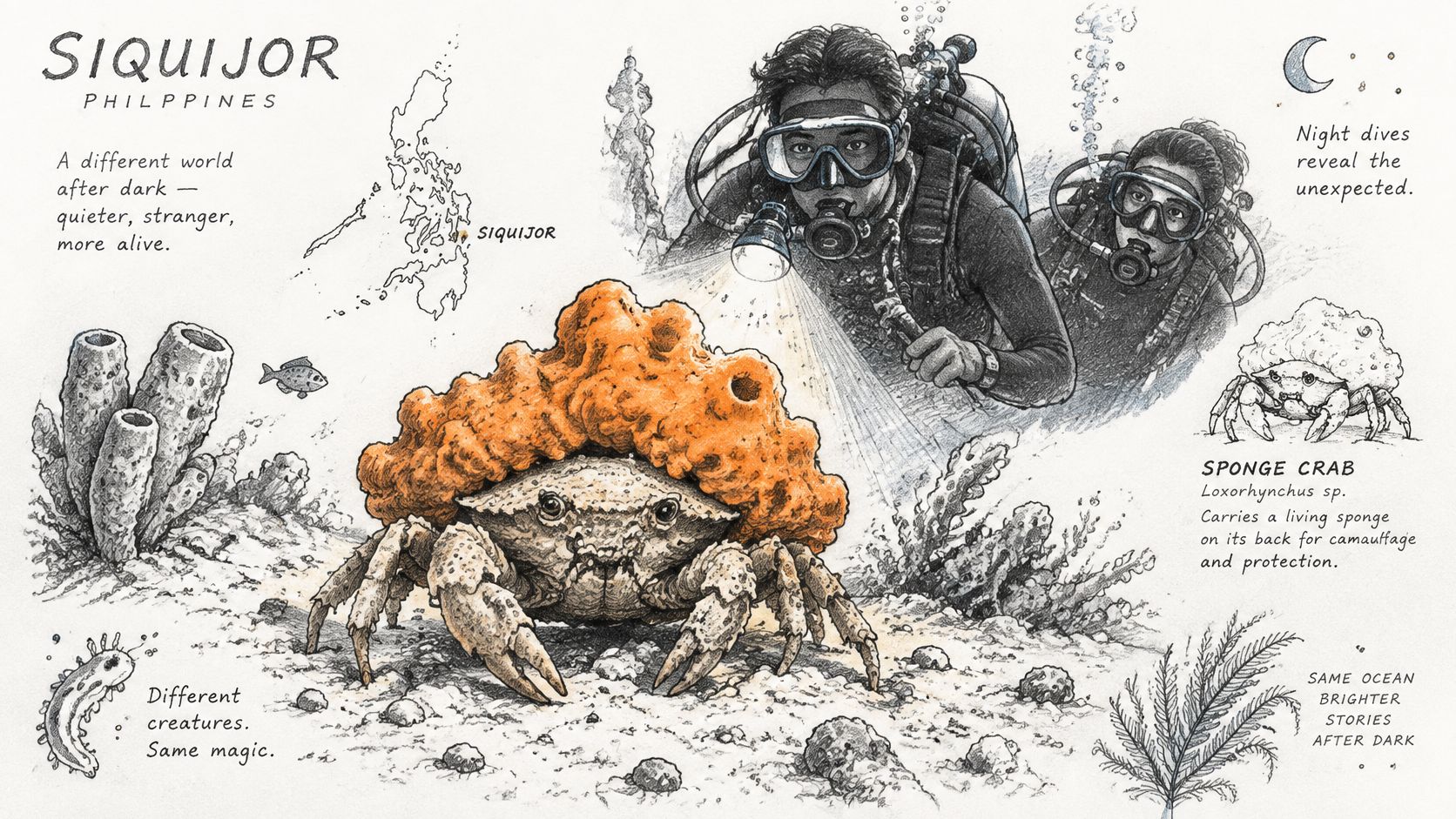
Our guide explained that sponge crabs are mostly active at night, which helps explain why I’d never seen one on my daytime dives.
They’re not impossible to encounter during the day, but night diving gives you a better chance of finding nocturnal animals out and about.
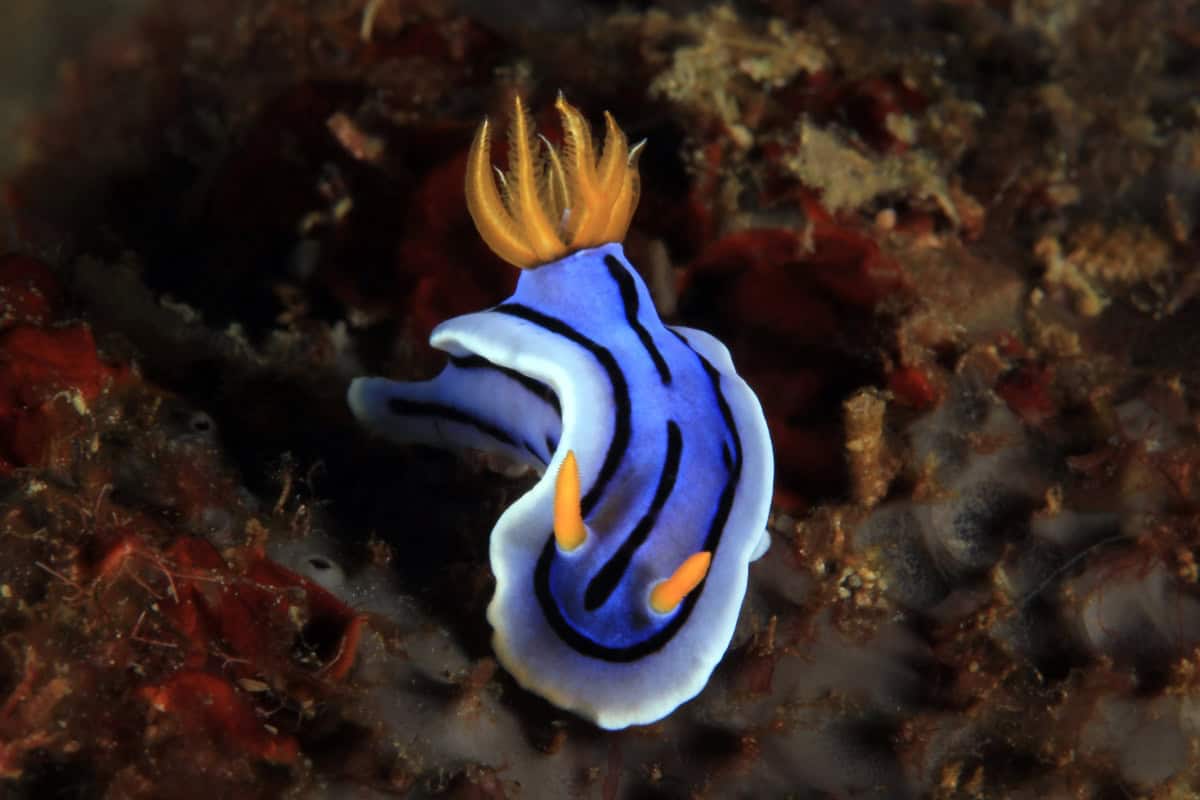
We also spotted octopuses and nudibranchs. On other night dives, I’ve seen fish resting almost motionless among the corals and even a turtle sleeping underwater.
Of course, sightings are never guaranteed. Some nights are busier than others, and what you see depends on the location and habitat. But even an ordinary reef can be really interesting when you take the time to look closely.
A NOAA-hosted blackwater-diving study conducted 59 recreational surveys off Kona, Hawai’i, between November 2013 and May 2015, recording 217 quadrant counts and 3,202 organism observations, or an average of 14.7 organisms per count.
Those offshore observations describe a different habitat from my reef dives, so they aren’t a promise of what you’ll see on a night reef dive.
A quick word about underwater lights and wildlife
Please be considerate when using your flashlight. DAN’s guidance on diving in the dark discusses adjustable illumination and why brighter isn’t always better. Avoid shining a powerful light at an animal for a long time, especially if it’s resting.
I know it’s tempting to keep photographing something unusual, but don’t chase it, corner it or touch it just to get a better picture.
And don’t forget your buddy while you’re watching that octopus! The photo can wait.
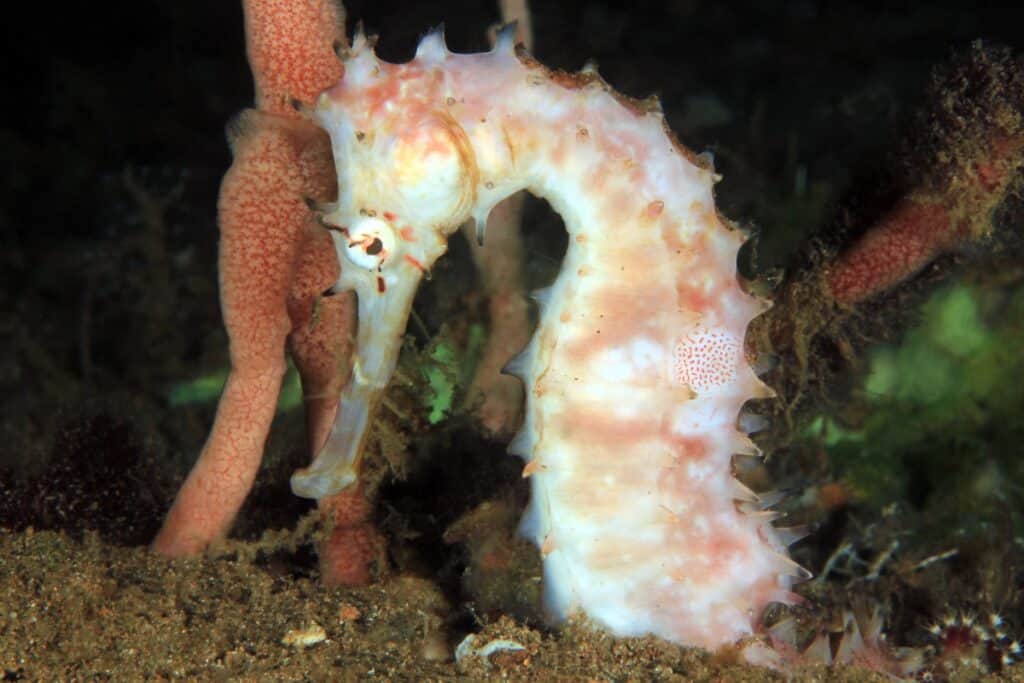
If you enjoy unusual marine-life encounters, you might also like my story about a diamondback squid egg mass. Here’s a moving look at the underwater setting:
Tips for Your First Night Scuba Dive
If you’re curious about night diving but feeling nervous, I completely understand. I felt exactly the same before my first one on Elba.
Here are a few things I’d recommend:
Go with an experienced instructor or guide. Having someone I already knew and trusted made all the difference during my first night dive.
Choose an easy, familiar dive site. Keep things simple while you get used to the darkness.
Practise using your light before entering. Know where the switches areand how to retrieve your backup.
Listen to the briefing. Pay particular attention to light signals, buddy positioning and the route back.
Go slowly. You don’t need to see everything in one dive. Take your time and enjoy what’s in front of you.
Speak up if you’re uncomfortable. If you become anxious underwater, stop, maintain buoyancy, keep breathing normally and signal your buddy or guide. Ending the dive safely is always an option.
You can also consider a night-diving specialty course. That’s how I learned, and I found the structured training really helpful. It covers the skills that are a little different at night, including communication and navigation.
If you’re packing for a trip that includes night diving, my dive-trip packing checklist is a good starting point.
PRO TIP: For your first night dive, I’d skip the underwater camera. Focus on getting comfortable with your flashlight, your buoyancy and staying with your buddy. You can bring the camera on another dive!
Night Scuba Diving FAQs
Here are the most frequently asked questions about night scuba diving:
Requirements depend on the operator, site and local rules. Some centres offer guided introductory night dives to suitably experienced certified divers, while others require or recommend additional training. Personally, I’d recommend learning with a qualified instructor if it’s your first time.
At least two: a primary underwater dive light and an independent backup. Check the batteries and make sure both work before entering the water.
It can feel intimidating the first time, and that’s normal. I was nervous too! The right dive site, a good briefing and an instructor you trust can make the experience much more comfortable. Don’t force yourself to continue if you’re genuinely uncomfortable.
Switch to your backup light, signal your buddy or guide and end the dive safely according to your briefing. Don’t continue exploring as though nothing happened.
You shouldn’t assume that night diving is automatically more dangerous because of sharks. Animal behaviour and potential risks depend on the species and dive location. Follow local guidance, avoid attracting or provoking wildlife and choose a site appropriate for your experience.
Yes, but I’d leave the camera behind for your first one if you’re still learning to handle the light and navigate in the dark. Once you’re comfortable, keep an eye on your buddy and buoyancy, and avoid disturbing marine life for a photo.
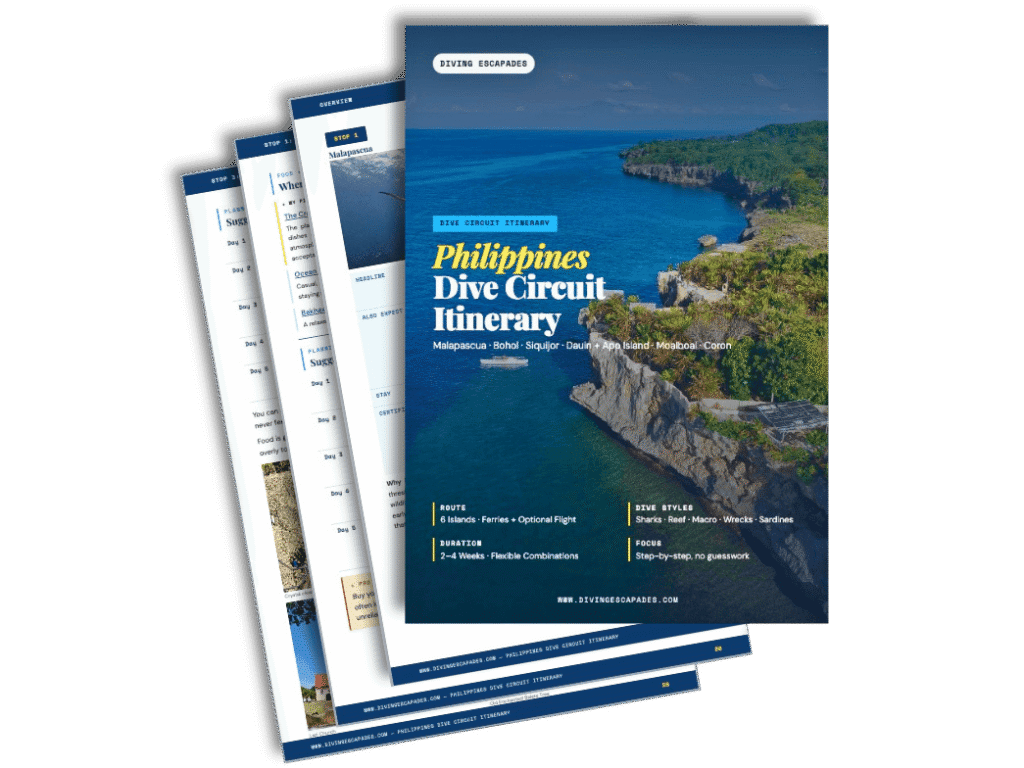
Planning the full Philippines dive circuit?
The Philippines Dive Circuit Itinerary covers Malapascua, Siquijor, and Bohol with day-by-day planning, dive site breakdowns, transfer logistics, accommodation picks and packing lists.
Everything in one place so you can stop researching and start diving.
Get the itinerary →
The Wrap Up: Night Scuba Diving
I still remember how nervous and excited I was before that first night dive on Elba in 2019. I’m so glad I tried it, because it’s given me the chance to see marine life and behaviour I might never have noticed on a daytime dive.
If you’re thinking of trying night scuba diving, my advice is to start with an experienced guide, choose an easy site and make sure you’re comfortable with your equipment and light signals.
Don’t feel you have to prove anything by going deeper or staying down longer than you want to.
And if you get lucky, perhaps you’ll find a sponge crab wandering around with an orange sponge on its back. Safe travels!